Impact Compass
Overview
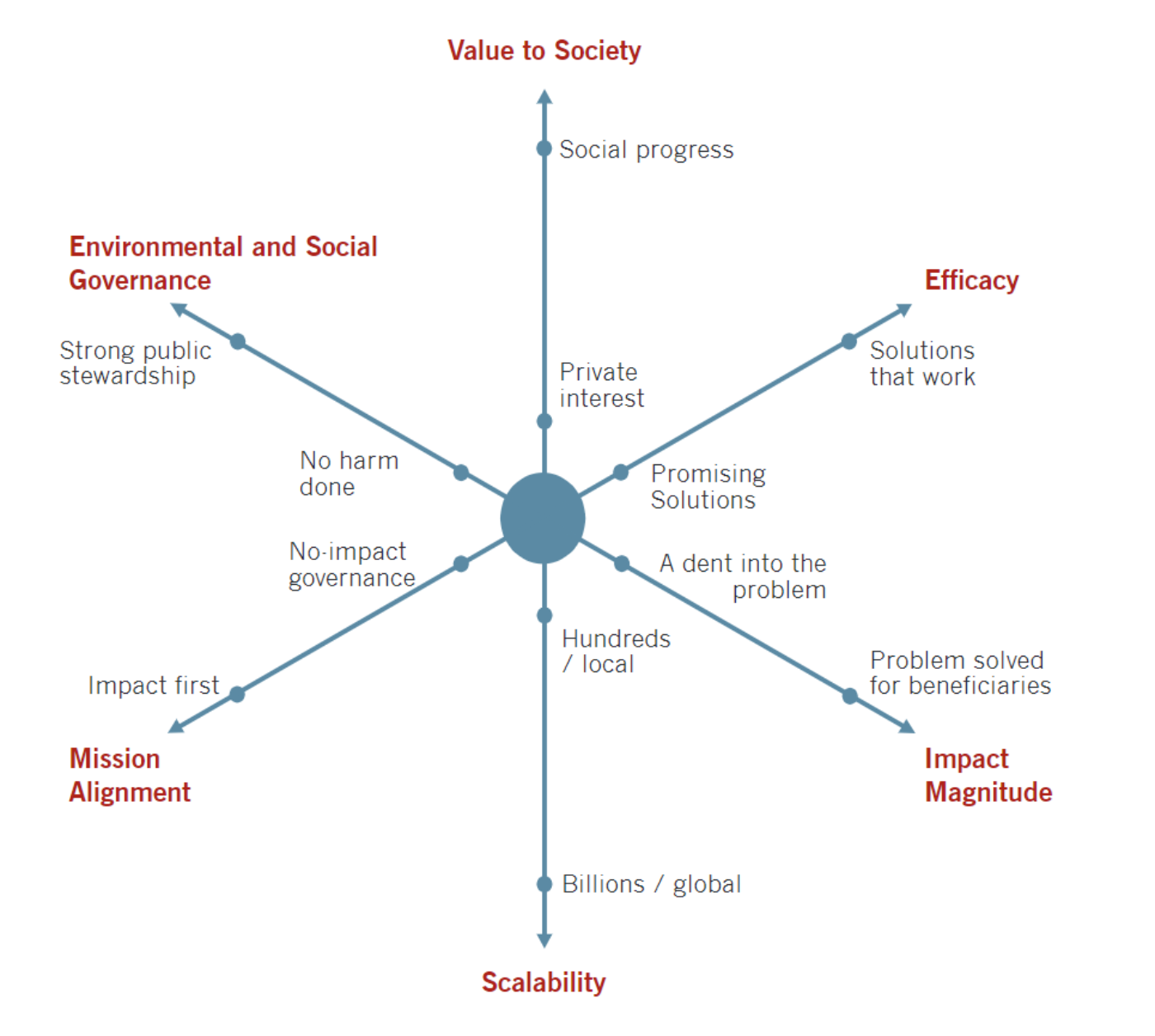
The Impact Compass is an analytical tool created by the Center for Social Innovation at Stanford University, designed to help individuals and organizations evaluate and maximize their social impact. It focuses on six key dimensions: value to society, environmental and social governance, mission alignment, scalability, impact magnitude, and efficacy. This tool is particularly useful for decision-making processes where the goal is to determine the most effective allocation of resources towards activities that generate positive social outcomes. The idea is to conform to three main principles: no proven failure, no negative societal outcome, and no unethical behavior. These three main principles are called the Three Big No’s. The goal for organizations is to clear the Three Big No’s and they maximize their impact by working with the six dimensions, each contributing to the overall evaluation of an entity’s impact potential.
Dimensions
Resource type: The Impact Compass is a strategic tool that provides a framework for assessing social impact. It draws on existing research methodologies, impact measurement practices, and insights from experts to create a framework that can be practically used to evaluate the social impact of different interventions.
- Tags: tool, framework
Objective: The primary goal of the Impact Compass is to assess and maximize social impact, making it a resource for strategic alignment and evaluation.
- Tags: assess, align
Target audience: This tool is designed for a wide range of users, including entrepreneurs, investors, and policy-makers, who are interested in understanding and enhancing the social impact of their decisions.
- Tags: entrepreneurs, investors, policy-makers, general-public
Sustainability focus: The Impact Compass inherently addresses social sustainability by evaluating the social impact of organizations and programs, but it can also be applied to environmental and economic sustainability considerations.
- Tags: social-sustainability, environmental-sustainability, economic-sustainability
Innovation type: While the tool explicitly aims to support social innovation by helping organizations to measure and understand the social change they aim to achieve, it can be a good support for other types of innovation that take into account concern related to social impact.
- Tags: social-innovation
Entrepreneurship stage: The Impact Compass is applicable across various stages of entrepreneurship, from ideation to maturity, as it helps to gauge the ongoing social impact.
- Tags: ideation, development, implementation, startup, growth, scale-up, maturity
Scope of relevance: While the tool can be used in diverse contexts, it is particularly relevant to global and national organizations that aim to assess their impact across different regions. According to the white paper it is particularly relevant for addressing local, national, and especially rural sustainability challenges,
- Tags: global, national, regional
Methodological approach: The Impact Compass is based on a theoretical framework that draws from extensive literature and expert insights in the field of social innovation. The six dimensions are multiplied together, rather than simply added up, to obtain an impact potential score, which represents the interactive power of each dimension on one another.
- Tags: theoretical-frameworks, quantitative
Skill development: Using the Impact Compass effectively may enhance skills in systems thinking, holistic thinking, and adaptability and resilience, as it requires a comprehensive understanding of an organization's impact within its context.
- Tags: systems-thinking, holistic-thinking, adaptability-and-resilience, social-awareness
Source and credibility: The tool is developed by a reputable academic institution and is grounded in scholarly research, making it a credible resource for assessing impact.
- Tags: academic-institutions, recognized-experts, research
Prerequisites and requirements: To utilize the Impact Compass effectively, users should have an intermediate understanding of impact assessment and social innovation concepts and a good understanding of how the six dimensions can be diligently graded.
- Tags: intermediate-level
Collaboration level: The tool can be used by individuals or teams within organizations to collaboratively assess and plan for social impact. But for meaningful outcomes, the tool suggests a cross-functional team effort that ideally also seeks input from the targeted community itself. This makes collaboration across disciplines, departments, and among diverse stakeholders essential.
- Tags: individual, team, cross-team-collaboration
More information can be found at Impact Compass | Stanford Graduate School of Business with an interactive compass tool. A webinar and a video guide are also provided.
Resources
Before using this tool, you should know...3 prerequisites • intermediate level
Impact Assessment
Intermediate understanding of impact assessment methodologies
Social Innovation
Good understanding of social innovation concepts
Six Dimensions Framework
Understanding of how the six dimensions can be diligently graded
Note: Requires intermediate level understanding to utilize effectively.
Tool Compatibility
See which tools work well alongside Impact Compass, and which overlap with it enough that you may only need one
Complementary Tools (10)
These tools work well together with Impact Compass
Adds mapping to the assessment this tool provides, from a business model angle.
Adds strategic alignment to the assessment this tool provides, bringing the SDGs into view.
Adds mapping to the assessment this tool provides, from a process innovation angle.
Adds strategic alignment to the assessment this tool provides, bringing environmental impact into view.
Adds mapping to the assessment this tool provides, from a business model angle.
Adds strategic alignment to the assessment this tool provides, from a business model angle.
Related Pages
Discover related resources based on shared tags and topics
UCD Impact Planning Canvas
tools
Project Resilience Review
tools
Future-Fit Business Benchmark
tools
UCD Impact Journey
tools
Sustainability Balanced Scorecard
tools