Future-Fit Business Benchmark
Overview
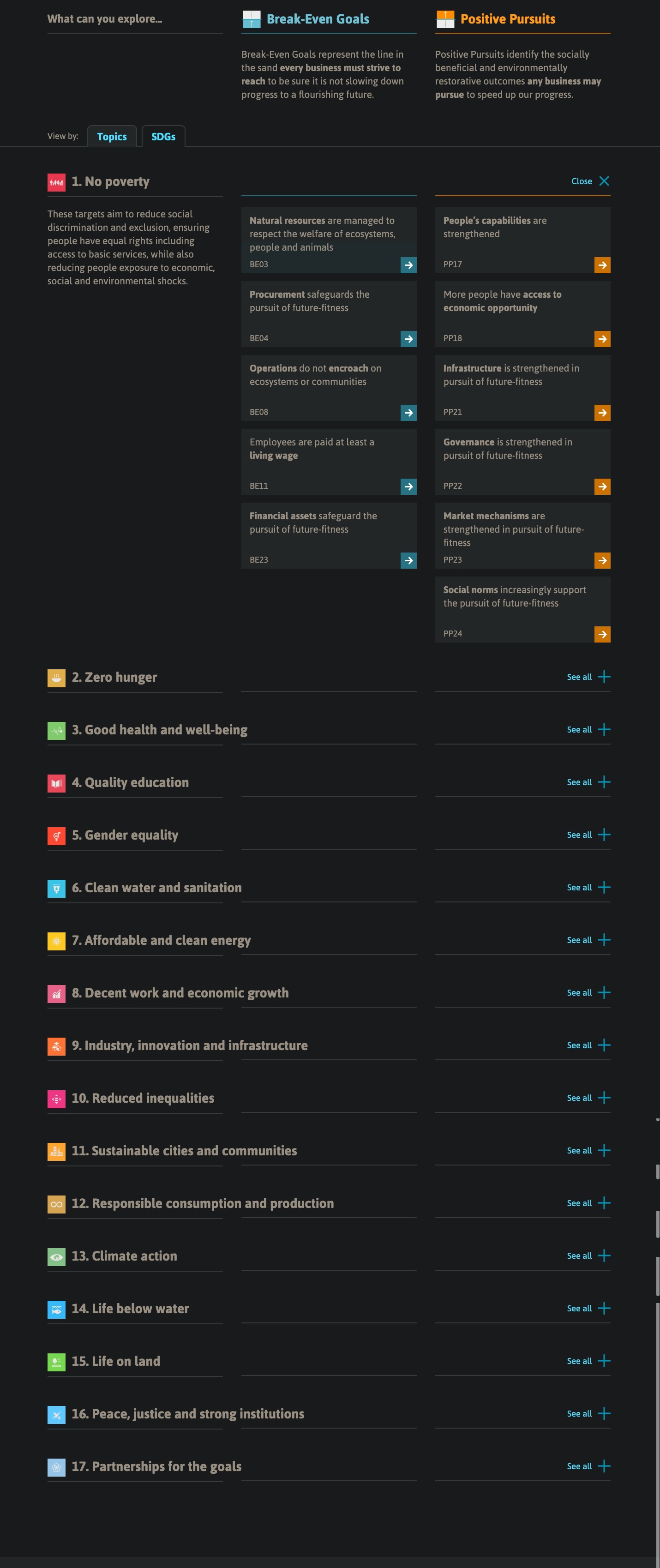
The Future-Fit Business Benchmark is an online tool consisting of principles, goals, indicators and guides. The approach is based on a solid, principles-driven definition of an ideal society for the future: a society where waste is eliminated, individuals have the chance and capability to lead fulfilling lives, renewable energy is accessible to everyone, and so forth. The set of 23 Break-Even Goals operationalize these principles by establishing minimum performance benchmarks that every business should aim to achieve. Furthermore, the 24 Positive Pursuits encompass the comprehensive spectrum of outcomes a business can contribute to accelerate societal progress. The Break-Even Goals come with a set of progress indicators, each quantified as a percentage. These indicators are crafted to assist businesses in recognizing risks, establishing interim targets, prioritizing actions, anticipating trade-offs, and monitoring progress..
Dimensions
Resource type: This is a method developed to help companies identify and asses their impact within governance, planet, people and prosperity.
- Tags: framework, method, online
Objective: This resource is aimed at guiding businesses to align their strategies with sustainable and equitable practices in line with the SDGs.
- Tags: align, assess
Target audience: The benchmark is designed for a wide array of users who are involved in or interested in sustainable business practices.
- Tags: entrepreneurs, researchers, policy-makers, investors, educators, practitioners, startups, SMEs, corporations
Sustainability focus: The Future-Fit Business Benchmark focuses on a holistic and comprehensive approach to sustainability. The benchmark emphasizes a range of sustainability dimensions to guide businesses toward becoming truly sustainable and contributing positively to society and the environment.
- Tags: environmental-sustainability, social-sustainability, economic-sustainability, environmental-impact, social-impact, governance, CSR, SDGs
Innovation type: While it is not directly linked to providing support for innovation, it can provide insights to many aspects related to innovation from new products and processes to business models and social change.
- Tags: product-innovation, process-innovation, business-model-innovation, social-innovation
Entrepreneurship stage: The benchmark is relevant for businesses at various stages, from initial concept to growth and maturity, although the benchmark is more relevant for existing organizations.
- Tags: ideation, design, development, implementation, startup, growth, scale-up, maturity
Scope of relevance: Its principles are universally applicable, making it relevant for businesses operating at any scale or location.
- Tags: global, regional, national, local
Methodological approach: The benchmark is grounded in a principles-based approach, ensuring robust and comprehensive guidance. Depending on the aspect that it guides, there may be need for qualitative or quantitative approaches.
- Tags: theoretical-frameworks
Skill development: Adopting the benchmark can enhance a range of competencies crucial for sustainable entrepreneurship. This is because it aims to attend to all 17 SDGs.
- Tags: leadership-and-management, systems-thinking, holistic-thinking, environmental-awareness, innovative-thinking, adaptability-and-resilience, business-and-financial-skills, collaboration-and-networking, data-analysis-and-metrics
Source and credibility: The benchmark is developed through a multi-stakeholder process that involves collaboration with experts, stakeholders, and organizations in the field of sustainability. The development process includes input from academia, industry professionals, and other relevant parties.
- Tags: peer-reviewed-publications, reputable-industry-sources, academic-institutions, recognized-experts, practice, research
Prerequisites and requirements: While accessible to all, the benchmark is best utilized by those with some foundational knowledge in business and sustainability.
- Tags: intermediate-level
Collaboration level: The benchmark encourages collaboration among various stakeholders to achieve sustainability goals.
- Tags: team, community, cross-sector-partnerships
More information can be found at Future-Fit Business. A complete guide why and how to use the benchmark is accessible at Future‑Fit Business Benchmark
Resources
Before using this tool, you should know...2 prerequisites • intermediate level
Business Fundamentals
Foundational knowledge in business operations
Sustainability Concepts
Understanding of sustainability principles
Note: Best utilized by those with business and sustainability knowledge.
Tool Compatibility
See which tools work well alongside Future-Fit Business Benchmark, and which overlap with it enough that you may only need one
Complementary Tools (10)
These tools work well together with Future-Fit Business Benchmark
Adds strategic alignment to the assessment this tool provides.
Adds strategic alignment to the assessment this tool provides.
Adds mapping to the assessment this tool provides, bringing circular economy into view.
Adds mapping to the assessment this tool provides.
Adds strategic alignment to the assessment this tool provides.
Related Pages
Discover related resources based on shared tags and topics
Project Resilience Review
tools
Social Impact Wheel
tools
Sustainable Business Model Canvas
tools
Circular Canvas
tools
Triple Layered Business Model Canvas
tools