UCD Impact Journey
Overview
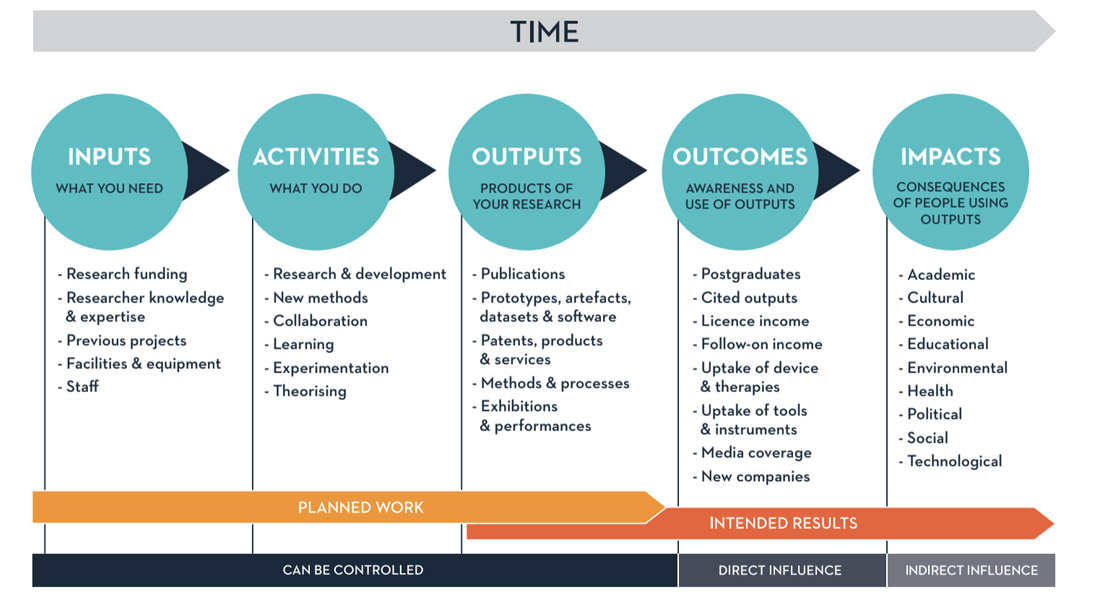
The Impact Journey is a strategic tool designed to assist researchers in planning, capturing, communicating, and monitoring the societal impact of their research. This is rooted in the W.K. Kellogg Foundation Logic Model and offers a structured approach to understanding the progression from research activities to long-term societal changes. It is particularly useful for researchers in sustainable entrepreneurship and innovation, as it helps in identifying the environmental, social, and economic impacts of their work. It is a versatile tool that can be used at any research stage and is instrumental in impact planning, including identifying collaborators and crafting impact sections for funding proposals.
Dimensions
Resource type: The Impact Journey is a descriptive and conceptual framework and practical tool that guide researchers through the process of achieving societal impact. ^a8e820
- Tags: tool, canvas
Objective: This resource aims to align research activities with their potential societal impact, ensuring that the outcomes contribute to sustainable development goals.
- Tags: align, map
Target audience: The primary users of this resource are researchers and academics, looking to maximize the societal impact of their work.
- Tags: researchers, educators, policy-makers
Sustainability focus: The Impact Journey emphasizes the importance of considering the long-term environmental, social, and economic implications of research by tracing research over time, distinguishing between different five stages on the pathway to impact.
- Tags: environmental-sustainability, social-sustainability, economic-sustainability, SDGs
Innovation type: The tool can result in different types of innovation, but is not designed as an aid to support innovation in research.
- Tags: process-innovation
Entrepreneurship stage: Similar to above, but the insights generated from this canvas can be relevant for the researchers entrepreneurial work.
- Tags: ideation, design, development, implementation, startup, growth, scale-up, maturity
Scope of relevance: While this tool can be used globally, they are particularly relevant for research that has a specific geographic or demographic focus, such as regional sustainability challenges.
- Tags: global, regional, national, local
Methodological approach: The Impact Journey is based on a logic model, which is a systematic and theoretical framework for planning and evaluating research impact.
- Tags: theoretical-frameworks
Skill development: The tool contributes to skill development in areas such as systems thinking, holistic thinking, and innovative thinking.
- Tags: systems-thinking, holistic-thinking, innovative-thinking
Source and credibility: The tool is developed by researchers at the University College Dublin, a reputable academic institution.
- Tags: academic-institutions
Prerequisites and requirements: It is designed for users with at least an intermediate level of understanding of research processes and impact planning.
- Tags: intermediate-level, specific-educational-background
Collaboration level: The tool encourages collaboration among researchers, stakeholders, and partners to maximize the societal impact of research.
- Tags: team, cross-sector-partnerships, public-private-partnership
More information can be found at Research Impact Toolkit.
Resources
Before using this tool, you should know...2 prerequisites • intermediate level
Research Processes
Intermediate level understanding of research processes
Impact Planning
Knowledge of impact planning methodologies
Note: Designed for users with research and impact planning experience.
Tool Compatibility
See which tools work well alongside UCD Impact Journey, and which overlap with it enough that you may only need one
Complementary Tools (10)
These tools work well together with UCD Impact Journey
Approaches environmental sustainability from a different angle, from a social innovation angle.
Adds assessment to the mapping this tool provides, from a social innovation angle.
Adds assessment to the mapping this tool provides, from a social innovation angle.
Adds assessment to the mapping this tool provides, from a social innovation angle.
Adds assessment to the mapping this tool provides, from a business model angle.
Adds assessment to the mapping this tool provides, from a social innovation angle.
Related Pages
Discover related resources based on shared tags and topics
UCD Impact Planning Canvas
tools
Project Resilience Review
tools
Sustainability Balanced Scorecard
tools
Triple Layered Business Model Canvas
tools
SDG Impact Assessment
tools