Biomimicry Design Spiral
Overview
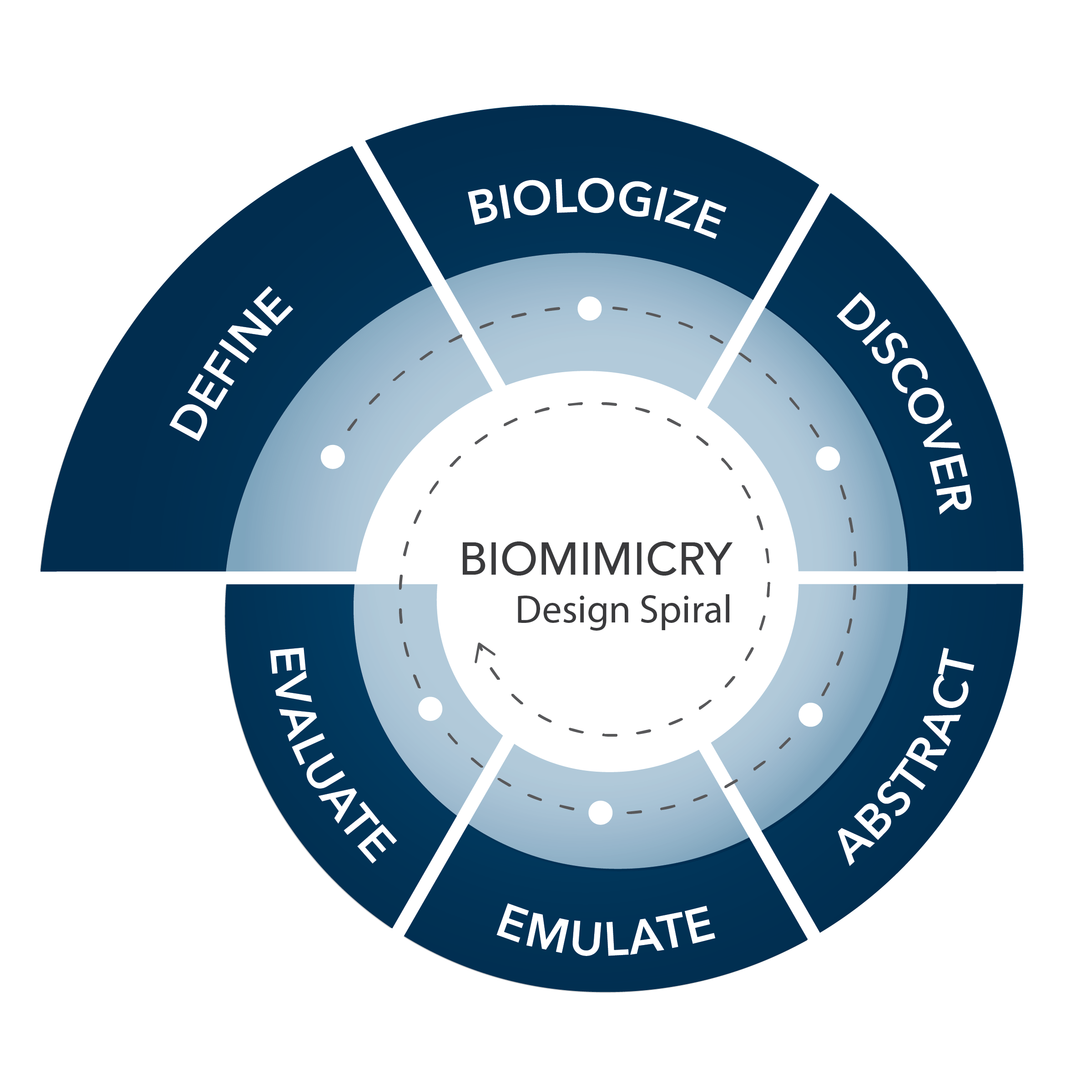
The Biomimicry Design Spiral is an innovative framework developed by Carl Hastrich in 2005, which integrates nature's strategies into the design process to address complex challenges. This structured approach consists of six iterative steps: Define, Biologize, Discover, Abstract, Emulate, and Evaluate. It encourages designers to draw inspiration from biological systems and apply these insights to create sustainable solutions. By utilizing this framework, designers and innovators can develop products and systems that are in harmony with the natural world, contributing to a more sustainable human civilization.
Dimensions
Resource type: The Biomimicry Design Spiral is a step-by-step methodological framework that guides the design process as an educational and practical tool for sustainable innovation.
- Tags: framework, method
Objective: The primary goal of the Biomimicry Design Spiral is to align design solutions with nature's principles, turning nature’s strategies into innovative and sustainable design solutions.
- Tags: align, assess
Target audience: This resource is particularly useful for entrepreneurs, researchers, and educators, but mainly designed for designers and design workers.
- Tags: entrepreneurs, researchers, educators, designers
Sustainability focus: The Biomimicry Design Spiral primarily focuses on environmental sustainability by seeking inspiration from nature's time-tested strategies, but also strides into socially related aspects of sustainability.
- Tags: environmental-sustainability, social-sustainability, economic-sustainability
Innovation type: The framework is agnostic of the type of innovation so in principle can support various types of innovation, particularly in product and process design, by emulating biological principles.
- Tags: product-innovation, process-innovation
Entrepreneurship stage: This resource is applicable across multiple stages of entrepreneurship, from initial ideation to the implementation of sustainable solutions. But it appears that similar to other tools, the earlier it is used, a wider space of action will be available to choose.
- Tags: ideation, design, implementation
Scope of relevance: The Biomimicry Design Spiral dose not discriminate between local or global.
- Tags: none
Methodological approach: The Biomimicry Design Spiral is a structured, iterative approach that combines both theoretical frameworks and practical application. In essence, it follows the methodology of the task it assists.
- Tags: theoretical-frameworks, experimental-design
Skill development: Utilizing this resource can enhance skills in systems thinking, creativity and design, and environmental awareness.
- Tags: systems-thinking, creativity-and-design, environmental-awareness
Source and credibility: Developed by an industrial designer and widely recognized in the field of sustainable design and is promoted by the Biomimicry institute.
- Tags: recognized-experts, practitioners
Prerequisites and requirements: To effectively use the Biomimicry Design Spiral, users should have a basic understanding of design principles and a basic command of sustainability.
- Tags: beginner-level
Collaboration level: The Biomimicry Design Spiral encourages collaboration, as it often requires interdisciplinary teams to emulate complex natural systems.
- Tags: team, cross-sector-partnerships, cross-team-collaboration
More information can be found at Biomimicry Institute.
Resources
Before using this tool, you should know...3 prerequisites • beginner level
Design Principles
Basic understanding of design principles and methodologies
Sustainability Fundamentals
Basic command of sustainability concepts and principles
Biology Basics
Basic understanding of biological systems and natural processes
Note: Works best with interdisciplinary teams that can bring diverse perspectives.
Tool Compatibility
See which tools work well alongside Biomimicry Design Spiral, and which overlap with it enough that you may only need one
Complementary Tools (10)
These tools work well together with Biomimicry Design Spiral
Adds strategic alignment to the assessment this tool provides, bringing environmental impact into view.
Adds strategic alignment to the assessment this tool provides, bringing environmental impact into view.
Adds mapping to the assessment this tool provides, bringing circular economy into view.
Adds strategic alignment to the assessment this tool provides, bringing environmental impact into view.
Adds mapping to the assessment this tool provides, from a business model angle.
Adds strategic alignment to the assessment this tool provides, bringing the SDGs into view.
Related Pages
Discover related resources based on shared tags and topics
Ecodesign Strategy Wheel
tools
Circular Design Toolkit
tools
Sustainable Business Model Canvas
tools
CircularStart
tools
Project Resilience Review
tools