Sustainable Value Analysis Tool (SVAT)
Overview
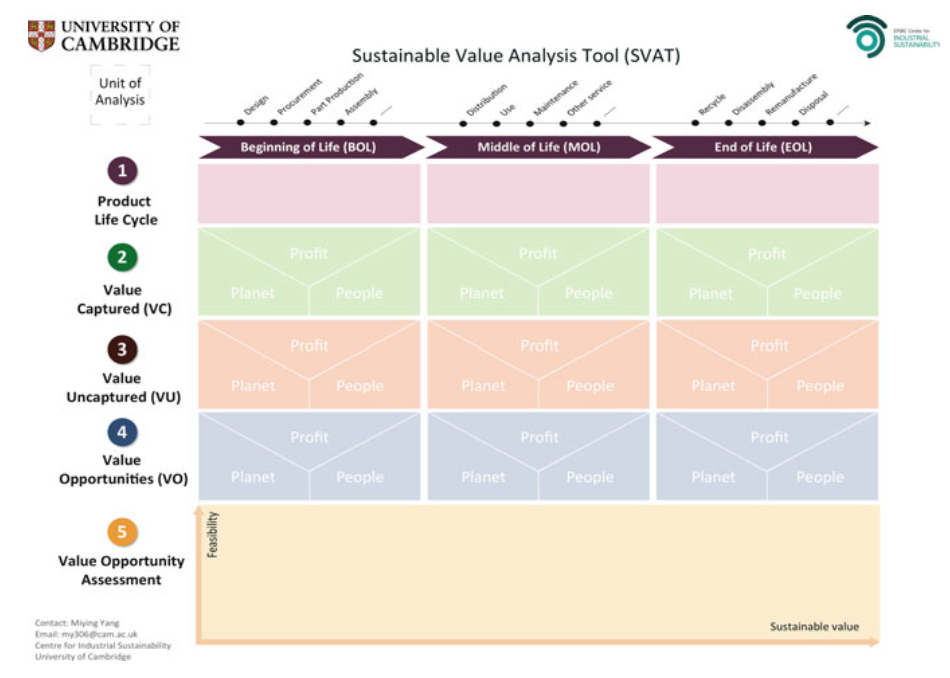
The Sustainable Value Analysis Tool is designed to aid manufacturers in recognizing and capitalizing on sustainable value creation opportunities throughout a product's life cycle. By analyzing captured and uncaptured value from the beginning of life (BoL), through the middle of life (MoL), to the end of life (EoL), the tool enables companies to systematically identify areas where value is missed, destroyed, surplus, or absent. It consists of a poster for visual mapping and a set of cards for guidance, combining life cycle thinking with value forms analysis. The five-step process involves defining life cycle stages, mapping stakeholder value, identifying uncaptured value, pinpointing value opportunities, and assessing their feasibility and sustainability. While the tool is comprehensive and strategically generates business opportunities, it may lack the necessary guidance on strategic planning for realizing these opportunities.
Dimensions
Resource type: This tool provides a structured approach and visual aids to help companies identify and leverage uncaptured value.
- Tags: tool, framework, method
Objective: The primary goal of this resource is to map out and assess the captured and uncaptured value throughout the product life cycle to make sure that the organization is aligned with sustainable practices.
- Tags: map, assess, align
Target audience: The tool is designed for stakeholders in the manufacturing sector, including entrepreneurs and companies focused on sustainability.
- Tags: entrepreneurs, practitioners, corporations, manufacturing
Sustainability focus: It addresses all three pillars of sustainability by considering environmental, social, and economic dimensions in value analysis at the same time and in relation to each other.
- Tags: environmental-sustainability, social-sustainability, economic-sustainability
Innovation type: The tool supports innovation in product life cycles and business models by identifying new opportunities for sustainable value creation. The tool itself is mostly designed to assess the sustainability relevance thoroughout the life cycle.
- Tags: product-innovation, business-model-innovation
Entrepreneurship stage: This resource is applicable across various stages of entrepreneurship, particularly in the design, development, and implementation phases where sustainable value creation is crucial. Similar to other tools, the sooner the assessment is done, the better an organization can react to align within principles of sustainability.
- Tags: design, development, implementation
Scope of relevance: There is no explicit reference to the scope, but the focus on the manufacturing sector signals its relevance both to local as well as global contexts.
- Tags: global, local
Methodological approach: The tool employs a systematic, life cycle-based approach to value analysis, which is both qualitative and strategic in nature.
- Tags: qualitative-research, theoretical-frameworks
Skill development: Users of this tool will enhance their skills in systems thinking, environmental awareness, and innovative thinking for sustainable entrepreneurship.
- Tags: systems-thinking, environmental-awareness, innovative-thinking, resource-management
Source and credibility: The tool is based on academic research and by researchers at the University of Cambridge and is based in the foundations of sustaunable development goals (SDGs).
- Tags: academic-institutions, recognized-experts
Prerequisites and requirements: The tool is designed for users with at least an intermediate level of understanding of sustainability and life cycle analysis in a business context.
- Tags: intermediate-level, specific-educational-background
Collaboration level: The tool encourages collaboration among different stakeholders involved in the product life cycle, from design to disposal.
- Tags: team, cross-sector-partnerships
More information can be found at Sustainable Value Analysis Tool (SVAT) – Miying Yang
Resources
Before using this tool, you should know...2 prerequisites • intermediate level
Life Cycle Analysis
Intermediate understanding of life cycle analysis (LCA)
Sustainability in Business
Understanding of sustainability concepts in business context
Note: Requires intermediate level understanding of LCA and sustainability.
Tool Compatibility
See which tools work well alongside Sustainable Value Analysis Tool (SVAT), and which overlap with it enough that you may only need one
Complementary Tools (10)
These tools work well together with Sustainable Value Analysis Tool (SVAT)
Adds strategic alignment to the assessment this tool provides, from a process innovation angle.
Adds mapping to the assessment this tool provides, bringing circular economy into view.
Adds mapping to the assessment this tool provides, from a social innovation angle.
Adds mapping to the assessment this tool provides, bringing circular economy into view.
Adds assessment to the mapping this tool provides, bringing the SDGs into view.
Adds strategic alignment to the assessment this tool provides, bringing circular economy into view.
Related Pages
Discover related resources based on shared tags and topics
Sustainability Balanced Scorecard
tools
Circular Business Model Planning Tool
tools
Triple Layered Business Model Canvas
tools
Social Impact Wheel
tools
Project Resilience Review
tools