Evolution of Design for Sustainability – From Product Design to Design for System Innovations and Transitions
Abstract
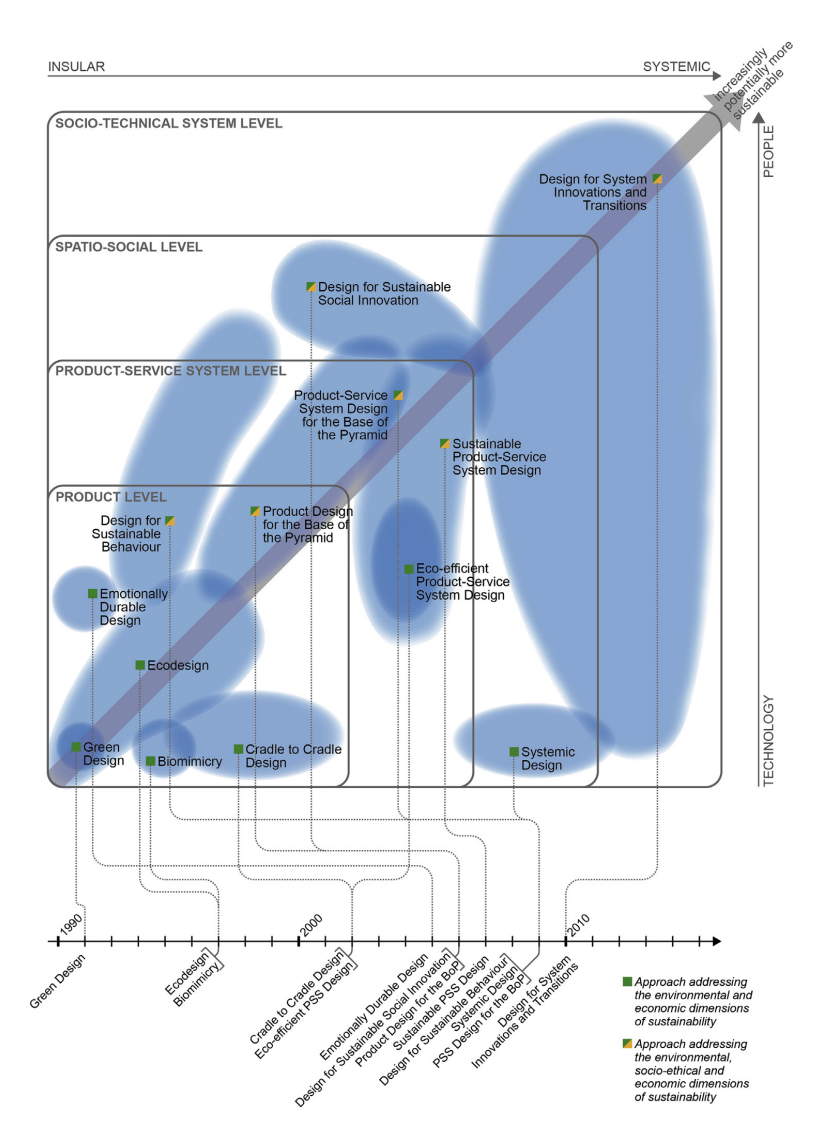
The paper explores the evolution of Design for Sustainability (DfS). Following a quasi-chronological pattern, our exploration provides an overview of the DfS field, categorising the design approaches developed in the past decades under four innovation levels: Product, Product-Service System, Spatio-Social and Socio-Technical System. As a result, we propose an evolutionary framework and map the reviewed DfS approaches onto this framework. The proposed framework synthesizes the evolution of the DfS field, showing how it has progressively expanded from a technical and product-centric focus towards large scale system level changes in which sustainability is understood as a socio-technical challenge. The framework also shows how the various DfS approaches contribute to particular sustainability aspects and visualises linkages, overlaps and complementarities between these approaches.
Citation: Ceschin, F., & Gaziulusoy, I. (2016). Evolution of design for sustainability: From product design to design for system innovations and transitions. Design studies, 47, 118-163.
The article is accessible here.
The analytical tool
 academic-articles
Related Pages
Discover related resources based on shared tags and topics
Sustainable by Design – An Organizational Design Tool for Sustainable Business Model Innovation
articles
The Triple Layered Business Model Canvas – A Tool to Design More Sustainable Business Models
articles
A Tool for Collaborative Circular Proposition Design
articles
Business Model Innovation for Circular Economy and Sustainability – A Review of Approaches
articles
Creating and Capturing Value Through Sustainability – The Sustainable Value Analysis Tool
articles